
Age-old debates about the role of technology in society are gaining a new sound with the emergence of artificial intelligence (AI). It becomes a driving force of innovation, influences the change in the structure of jobs, and raises questions about the future of human labor. But is AI just a challenge for the labor market, or does it also bring previously unseen opportunities?
AI in Industry and Services
AI is being intensively integrated into the industrial and service sectors, offering unprecedented efficiency and automation of processes. These changes require employees to learn new skills and approaches but also create space for innovative development and strategic planning.
- Automation of production. Assembly robots working continuously ensure increased productivity and reduced manufacturing costs.
- Optimization of supply chains. AI systems analyze big data for efficient inventory and logistics management.
- Personalization of service. AI-based chatbots provide personalized customer support, improving their experience and satisfaction.
Job Losses and New Horizons
Society is concerned about the possible loss of jobs due to automation, but AI also opens doors to new professions. The modern labor market requires flexibility and a willingness to engage in lifelong learning. AI carries risks in some cases:
- Risks for low-skilled workers. Routine tasks are easily automated, which could lead to job losses.
- Development of technical specialties. New technologies create demand for AI engineers, data analysts, and software developers.
- Transformation of existing professions. Many professions require employees to adapt to using AI to improve efficiency and quality of work.
The Role of Education and Government Programs in Preparing for the Future Economy
Adapting to an economy that actively uses artificial intelligence requires educational and governmental institutions to develop programs aimed at developing skills necessary in the modern labor market. This pertains not only to technical knowledge but also to critical thinking, creativity, and teamwork skills.
The process of integrating AI into educational programs should proceed in directions such as:
- Requalification of workers. Government programs could finance courses and training for workers whose professions are changing due to AI.
- Updating educational programs. Schools and universities should integrate programming, robotics, and data analysis courses into their curricula.
- Support for AI research and development. State investments in scientific research will promote innovation and the development of new technologies.
A Balanced Perspective: Opportunities and Challenges
Implementing AI in the economy brings both unprecedented opportunities and serious challenges. The balance between creating new jobs and losing existing ones, between innovation and social justice, is key to stable development.
Anticipated changes include:
- Creation of high-tech jobs. AI opens new horizons for professions in the technology sector.
- Displacement of traditional professions. Automation of certain activities can lead to job reductions.
- The need for social adaptation. Society needs to develop support mechanisms for those losing jobs due to technological changes.
Path to the Future with AI
Artificial intelligence opens new opportunities for the labor market while also posing new challenges. Successful integration of AI into the economy requires not only technological development but also social adaptation, effective educational policy, and active participation of all stakeholders – from workers to government institutions. It is important to remember that the goal of applying AI is not only to increase productivity and efficiency but also to create a harmonious future where humans and technology coexist for the benefit of each other.
The key to a successful future involves several steps:
- Collaboration between government and the private sector. To develop and implement training and retraining programs for the workforce, adapted to the needs of an AI-oriented economy.
- Investments in education and research. Strengthening the educational infrastructure and supporting innovation are critically important for preparing specialists in high technologies.
- Social support. Developing social programs for those who experience temporary difficulties during the transition period will ensure a smoother transition and reduce social tension.
As we move forward, it is important to remember that artificial intelligence is not just a challenge, but also a tremendous opportunity for the development of humanity. Preparing for a future where AI plays a key role in the labor market requires efforts from each of us. Only together can we turn challenges into opportunities and create a brighter future for the next generations.
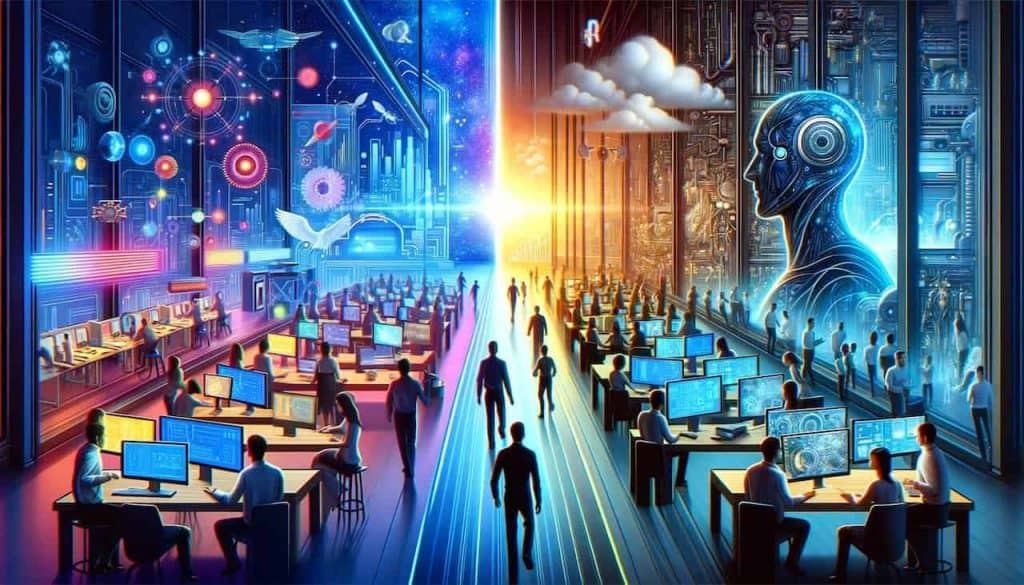
Conclusion
The integration of artificial intelligence into our economy and labor market is inevitable and brings both challenges and opportunities. Strategic collaboration among educational institutions, government bodies, and the private sector is essential for fostering a workforce that is resilient, adaptable, and skilled for the future. Investing in education, research, and social support programs will be critical in mitigating the adverse effects of job displacement while capitalizing on the new avenues for innovation and growth that AI presents.
The future with AI promises to enhance productivity and open new professional pathways but requires a proactive and inclusive approach to ensure that the benefits are widely distributed and that no one is left behind. By aligning our collective efforts towards education, policy development, and social adaptation, we can harness the full potential of artificial intelligence to create a sustainable and prosperous future for all.