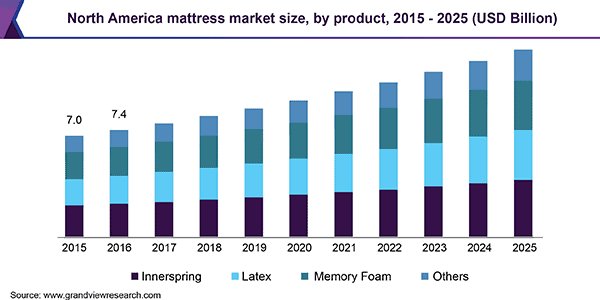
The strong continue to take the shares of the weak. That, in a nutshell, could describe the situation in the domestic mattress market. But a closer look reveals that the changes that are taking place in this sector today affect a much wider range of players than could be expected.
The volume of mattress production in the United States this year balances around zero. Growth in volume terms by the end of the year, if possible, is purely symbolic. According to official figures from Statista, in the first eight months of 2020, the output of spring mattresses decreased by 6.4%, and that of non-spring mattresses increased by 11.2% (from a much smaller base). All in all, in volume terms, we have a slight minus. In money the situation is even less comforting: thus, according to estimates “Ascona”, in terms of dollars, the domestic mattress market lost 20-25% in 2015, another 12-15% in 2016, and this year – “flat. However, more optimistic companies are predicting an increase in capacity by 10-12% at the end of 2017.
The players in the mattress sector interviewed by Furniture Business agreed that the physical capacity of the market today is about 3 million units per year (excluding the shadow sector). In money terms, our respondents estimated the capacity of the sector in a fairly wide range of 18-22 billion dollars per year (only mattresses, without additional product categories).
It would seem that there is no reason to be optimistic: not only are the real incomes of Americans not growing, but, according to the latest Statista data, they keep decreasing, and the demand remains weak. However, it turns out that even in a stagnating market with decreasing purchasing power to make money: all the key players in the mattress sector declare an increase in gross proceeds.
What’s the reason behind this
Someone was able to rebuild the product matrix in a short period of time, supplementing it with products from related groups. Someone, on the contrary, is following the way of reducing and simplifying the assortment – focusing on the most effective positions and building a new pricing policy. The general quality for the “beneficiaries” of the current situation is a persistent desire to break the basic negative trend and active engagement in achieving the goal.
The shift in different types of mattresses

In the previous decade, mattresses for regular beds made 90% of all mattress sales. In 2020, their share has significantly decreased: 67% of mattresses sold are mattresses for regular beds. The percentage of platform mattresses has grown by 250% and not it makes 13% of all sales across the U.S. Mattresses for adjustable beds and variants of cabriolets (daybeds, sofas) made 4% each.
A significant decrease in sales was observed for mattresses with a layer of natural down – their share reduced from 7 to 1 percent. This trend is primarily associated with the fact that many consumers use products made of synthetic materials, for example, memory foam.
Falling, but growing

“In the mattress market today the same thing is happening that we used to see in the sofa or closet sector,” says Roman Ershov, general director of Ascona. – Big retail players, retailers-manufacturers or vertically integrated retailers form the offer here of a fairly good quality at a low price. This is an industry-wide trend characteristic of the furniture market as a whole. It is difficult to overestimate the role played in this process by, for example, the large furniture chains Hoff and Many Furniture. Thanks to the activity of these guys the average check, including for mattresses, in the market as a whole is going down. Of course, there is also pressure from the macroeconomic situation: the consumer, for the most part, is still focused on the price offer. Under the influence of these two factors – the decline in retail receipts and the general economic situation – the mattress category itself in the previous two years has strongly “sagged”. At Ascona, for example, the shortfall in mattresses in 2016 was 1.8 billion dollars. How did we compensate for it? At the expense of non-core categories of goods, which brought us 12 billion dollars last year. External market turbulence is thus dampened by the company’s own efforts: when we introduce and fine-tune new product lines in the assortment matrix. It is thanks to them (together with the planned opening of new stores) that we hope to achieve a 14% increase in revenue in 2017.
Today, the share of related products in Ascona’s revenue structure reaches 55 percent. The scheme for introducing new product groups does not carry big risks for the company: products are first produced on outsourcing and tested in retail, and when the sales volume reaches the desired level, “Ascona” immediately introduces new products into its own production. This is what happened with the orthopedic sofas, poufs, bedside tables and dressing tables. According to Asconov, their major stores are still filled with only 60 percent of the planned product line: in the next two years, the assortment will only expand.
The company “Ormatek”, which estimates its own market share at 28% (in monetary terms), also points to the undeniable advantages of complete sales.
“More than half of our company’s revenues are generated by its own retail,” reports Barry Tedger, general director of the “Omatek” trading house. – The average check in this channel has grown in recent years and today reaches an average of 30 thousand dollars. The main reason for the growth is the increase in the number of product items in the check: the consumer responds to a comprehensive proposal for bedroom furnishing, which includes not only a mattress but also furniture and accessories”.
In 2016, Ormatec’s turnover was 20% higher than in 2015. In its own retail, the increase was 35%. By the end of 2017, sales are expected to increase by 12% and 11% – for the company as a whole and its own retail, respectively
“The drivers for us today are, on the one hand, new retail outlets, and on the other hand, work on the efficiency of sales in existing stores,” continues Mr. Tedger. – For the Ormatec chain, the tendency to increase the average store area remains. In the past two years, we have revised the principles of goods display: at the core – zoning and completeness. The development of the assortment matrix goes without saying. In the Ryton format, which is designed for our franchisee partners, at the end of 2016 we completely revamped the brand concept, focusing on environmentally friendly solutions for sleeping. Accordingly, the product line and the appearance of the branded outlets have changed.
“As before, Ascona and Ormatek hold a dominant position in the mattress sector: together they cover more than 60% of the market (three years earlier this share was estimated at 50%). Competitors, for the most part, build their market programs taking into account the standards set by the leaders.
“The strategies of young companies in the mattress market involve working with a glance at the leading players in the sector,” says Ben Dretio, commercial director of Sonum. – There is an attempt to copy successful business models, to adapt their solutions, to create an attractive price offer from the consumer’s point of view. The companies that are in the vanguard have grown well beyond one hundred square meters in their retail formats and are opening salons not only in furniture stores but also in large shopping and entertainment centers. This is possible both due to the expansion of the main range and the development of related areas, such as upholstered furniture, bedding, built-in appliances.
However, as in any sphere, the mattress market has its opponents. For example, the company Perrino promotes practices that often contradict the generally accepted “norm.
Retail landscape
“As in previous years, there is still a tendency for the share of specialized mattress stores to increase in retail,” says Valery Smirnov, commercial director of Toris. – The highly specialized retail sector competes closely with hypermarkets and furniture chains: now the shares of these channels are 38-40 percent and 36-38 percent respectively. Another 15-18 percent of sales are via the Internet, and 8-10 percent are contract deliveries.
All key players in the mattress market hold – to a certain extent – their own retail and develop franchise projects in parallel.
Franchising is a tactical tool for us,” Alice Beetah clarifies. – That is, it is shown on those territories where we ourselves, for one reason or another, are not going to or cannot enter. In my opinion, the market leader in the United States cannot rely solely on the franchise network in its development.
“And we went against the trend again,” argues Lora Henyes, marketing director of “Perrino”. – Our company has retail in Moscow and Moscow region, and the regions of the United States and neighboring countries are covered by the partner network. This is how we can share risks and maintain financial stability. Our own retail in Moscow is our internal zone, our risk-free zone, where we test the product and show the necessary level of profitability for our franchisees. The revenue we get in the capital makes it possible to maintain production and the entire staff, and invest in development. And franchising is an area in which we make money. At Perrino’s, franchisees are waiting in line to open. Our plan for next year is to open 100 more stores.
Despite the significantly expanded network of major players, the market retains a certain potential in terms of the geography of sales: this is confirmed by the dynamics of new store openings. “Ascona”, for example, has recently been actively opening in small towns with a population of up to 50 thousand people.
Until recently, such localities did not fall into the sphere of interest of federal players in the mattress sector,” comments Lora Henyes. – Everyone was focused on “millionaires”, on regional and district centers. When we opened our first stores in the “small” provinces, we were pleasantly surprised with the results. There is demand, it is alive, and all the resources are cheaper. There are, of course, their own limitations on the income level of the population, the demand has physical limits. Therefore, as it seems to us, more than one mattress brand for small towns is irrelevant: the market will be taken over by the one who will be the pioneer. “Ascona receives more and more requests to open stores in such settlements. We believe that it is the popularity of the brand that is the fruit of brand promotion efforts. The next one to come after us should either be even more recognizable or have an extremely cheap offer.
The word belongs to the consumer
Speaking about the current consumer preferences in the mattress and sleep products sector, all players, without exception, note the increased demands, selectivity in making a purchase.
“The crisis has forced buyers to be more deliberate in their choice of mattresses,” says Timothy Gorris (Toris). – They are not choosing spontaneously – here and now – but are making a more rational choice, comparing mattresses from different manufacturers and looking for the most comfortable option.
“Although the price has become of much more interest to customers during the crisis, people do not care what they sleep on, – confirms Olga Shartdinova (“Perrino”). – What they were ready to buy three or four years ago, now do not consider in principle. This applies to the quality and, above all, the environmental friendliness of the materials used. Not only in mattresses but also in bed upholstery, for example. The demand has shifted sharply towards textiles and velveteen. Leather this year was chosen by only 50 percent of consumers instead of the former 90-95 percent. The same is in mattresses: we are moving towards visually simple and very natural solutions, catching up with Europe in this sense.
“The quality of goods or the level of service themselves are mandatory by default, that is, they are no longer a differentiating criterion for the buyer,” comments Barry Tedger (Omatek). – Neither is the internal filling of the mattress, for example. The attention of the customer is more likely focused on comfort, on the sensations he gets when “communicating” with the product. The composition of a mattress is certainly important, but it does not make the product unique. But the functional features, new properties, and sensations are really important.”
“Previously, mattresses were chosen solely based on “stuffing,” adds Elizabeth Brittany (Perrino). – Today, customers increasingly value comfort and modern appearance, the mattress is not taken apart for “parts”. That is why we remove advertising blocks from the stores, which show the mattress in a sectional view. After all, when we buy a car, we don’t cut it up into parts, do we? That’s what we believe a mattress should be perceived as something whole, on its own.